
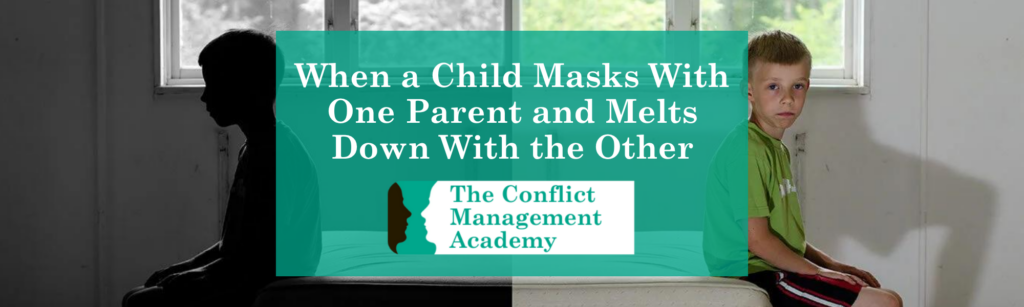
You meet two separated parents. Each describes a child you would struggle to recognise as the same person. One parent talks about a calm, capable, easy kid who never gives them any trouble. The other describes daily meltdowns, exhaustion, and a child barely holding together by the end of the afternoon.
Both are telling the truth about what they see. That gap is a common starting point in family work involving a neurodivergent child, and it sets up a particular kind of blame.

The same child, two presentations
When a child masks, they suppress and manage their distress through the parts of the day that demand it, then release it once they reach a setting that feels safe. The research base for this is the camouflaging literature. Hull and colleagues (2017) documented why autistic people mask and what it costs them and went on to build the Camouflaging Autistic Traits Questionnaire (Hull et al., 2019). Cage and Troxell-Whitman (2019) measured masking across different contexts, including family compared with more formal settings, and found that some people mask heavily everywhere while others drop it in places that feel safer or more familiar.
Masking is effortful, and the effort is linked to exhaustion, anxiety, and depression. Holding it in place through a demanding day leaves little in reserve. When the demand drops, the child releases what they have been holding.

Why the meltdowns land with the co-regulating parent
The release tends to land with one person rather than spreading evenly, and attachment theory explains why. Children organise their attachments into a hierarchy and turn to a principal attachment figure for comfort when distressed, with that safe-haven behaviour directed there most strongly under high stress. The parent at the top of that hierarchy gets the meltdowns, because they are the one the child trusts enough to fall apart in front of.
Co-regulation sits alongside this. A 2025 review in the Journal of the American Academy of Child & Adolescent Psychiatry treats parent–child co-regulation as a central mechanism in how autistic children develop emotional regulation, working both moment to moment and over the longer term. The co-regulating parent is doing real developmental work, and the meltdowns are part of that work.
No single study shows that a neurodivergent child has one main parent who absorbs the dysregulation. The pattern is assembled from these literatures, attachment hierarchy, co-regulation, and the release of masking in safe relationships, which together support it as a clinical reading.

Why that parent gets blamed
The parent who sees the meltdowns is the parent in the room when the distress shows, which makes them look like its source. The child is “fine” everywhere else, so the difference seems to be them.
The reverse reading fits the evidence more closely. The child melts down with that parent because that parent is safe enough to melt down with. The calm the other parent sees is the cost being paid out of their sight.
Damian Milton’s double empathy problem (2012) describes how two people with different neurologies struggle to read each other, with the misreading running both ways. A parent who experiences the child as “fine with me” may be missing the masking altogether, because the child is working hard to stay acceptable to them and is succeeding.

What separation adds
A qualitative study by Gentles and colleagues (2020) followed how parents come to understand their child is autistic. Mothers in that study described partners, often fathers, who stayed in denial longer, and who sometimes obstructed assessment or support. The study interviewed mothers rather than fathers, so the gendering reflects who was asked, though the pattern of one parent accepting and one resisting is one many of us recognise.
Drop that pattern into a separated family already cycling through blame, and it hardens. The parent who denies the disability has a ready explanation for the meltdowns the other parent reports: poor parenting, a chaotic household, coaching the child, exaggeration. “They’re completely fine with me” becomes evidence.
The child’s masking, the very thing that makes one home calmer, gets read as proof that the other home is the problem. The co-regulating parent then carries two loads at once: the meltdowns themselves, and the accusation that they are causing them.

What the cross-informant research shows
This pattern is documented well beyond autism. When different people rate the same child’s behaviour, they routinely disagree, and that disagreement is one of the most consistent findings in child mental health research.
Achenbach, McConaughy, and Howell’s (1987) meta-analysis of 119 studies found that agreement between different types of informants, such as a parent and a teacher, averaged around r = .28. Agreement between more similar informants, such as two parents, ran higher but stayed moderate, around r = .60. Two parents watching the same child arrive at meaningfully different pictures.
The older interpretation treated this as error or bias, with one informant assumed to be exaggerating or missing things. The interpretation set out by De Los Reyes and colleagues (2015) is that these discrepancies carry real information. Children behave differently across settings and with different people, so each observer captures a genuine and partial slice. Achenbach had made the same point in 1987, noting that the low correlations did not mean the reports were unreliable, since each informant was describing the child they actually saw.
For a child who masks, the divergence runs wider than these averages, because the child is actively producing different behaviour for different audiences. Two parents describing two different children is the expected result. It does not show that one of them is failing.

What this asks of us
Knowing this, the pull is still to treat one account as accurate and the other as distorted, especially when the parents are already in conflict. Both accounts can describe what each parent genuinely sees and still point to one explanation neither has full view of.
A few things that help me hold impartiality in this situation:
- I treat “they’re fine with me” as real information about that setting, without letting it settle the question of what the child is managing elsewhere.
- I stay alert to the inference that the parent present for the meltdowns must have caused them. Being present when distress appears does not mean producing it.
- I keep the child’s experience in view as the thing both parents are describing from different positions, rather than refereeing whose account wins.
None of this requires me to diagnose the child or to decide whether they are autistic. It requires noticing when a blame story is being built on top of a masking pattern and declining to reinforce it.
Questions to sit with
- When parents describe very different children, how do you currently decide which account to rely on, and what shifts if you treat both as partial?
- Where might “the child is fine with me” be operating as evidence in a matter you are working with right now?
- How do you respond to a parent who reads the other parent’s reports of meltdowns as fabrication or poor parenting?
- What would it take to name this dynamic for parents without appearing to take a side on the disability itself?
Working with Neurodivergent Clients in Conflict: Foundations
Understanding neurodivergence can make a significant difference to how we interpret behaviour, communication and emotion in conflict. Working with Neurodivergent Clients in Conflict: Foundations offers practical, research-informed strategies to help conflict practitioners build more inclusive, flexible and empowering processes.
Learn more about the course: https://conflictmanagement.tangiblelaunchpad.com/working-with-neurodivergent-clients-in-conflict-foundations
BETA: Working with Neurodivergent Clients in Family Conflict
Family conflict involving neurodivergent children can bring complex dynamics, different experiences and very different accounts of what is happening. Working with Neurodivergent Clients in Family Conflict explores how practitioners can approach these situations with greater understanding, curiosity and impartiality, while keeping the child’s experience at the centre. As a BETA course, this is an opportunity to engage with the material and contribute to its development.
Explore the BETA course: https://conflictmanagement.tangiblelaunchpad.com/working-with-neurodivergent-clients-in-family-conflict/
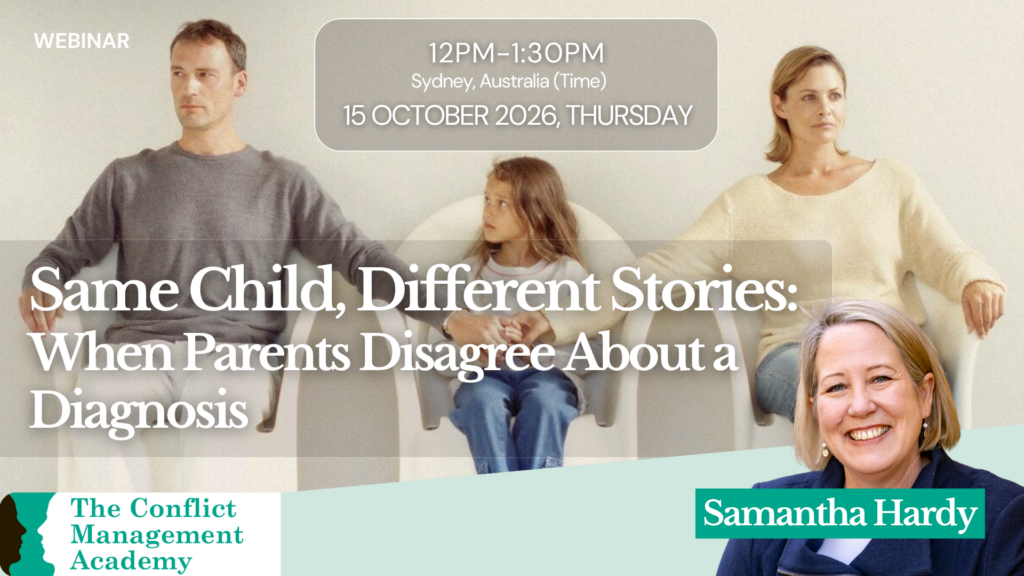
Webinar: Same Child, Different Stories
When separated parents describe the same neurodivergent child in very different ways, it can be easy to assume one account is right and the other is wrong. Same Child, Different Stories explores masking, co-regulation, attachment and differing perspectives, and how practitioners can remain impartial while keeping the child’s experience at the centre. Join us Thursday, 15 October 2026, 12:00pm–1:30pm Sydney time.
Register for the webinar: https://conflictmanagement.tangiblelaunchpad.com/webinar-same-child-different-stories/

Resources
- Running, A. (2026). We Need to Talk About Autism and Parent-Carer Blame: How and why parents face blame, and what we can all do about it. Jessica Kingsley Publishers.
- Hollingworth, D., Ferguson, L., Schaub, J., & Kempson-Byrne, S. (2023). Autism and Parental Blame: A Systematic Literature Review.
- Clements, L., & Aiello, A. L. (2021). Institutionalising Parent Carer Blame: The Experiences of Families with Disabled Children in Their Interactions with English Local Authority Children’s Services Departments. Cerebra / University of Leeds.
- Gentles, S. J., Nicholas, D. B., Jack, S. M., McKibbon, K. A., & Szatmari, P. (2020). Coming to understand the child has autism: A process illustrating parents’ evolving readiness for engaging in care. Autism, 24(2), 470–483.
- Cassidy, J., & Shaver, P. R. (Eds.). Handbook of Attachment: Theory, Research, and Clinical Applications. Guilford Press. (Standard reference on the attachment hierarchy and the principal attachment figure.)
- Review and Developmental Model: Early Childhood Emotion Regulation and Co-Regulation in Autism (2025). Journal of the American Academy of Child & Adolescent Psychiatry. doi:10.1016/j.jaac.2025.07.1063 (Carla Mazefsky among the authors.)
- Hull, L., et al. (2017). Qualitative study of camouflaging motivations and costs in autistic adults. Journal of Autism and Developmental Disorders.
- Hull, L., Mandy, W., Lai, M.-C., et al. (2019). Development and Validation of the Camouflaging Autistic Traits Questionnaire (CAT-Q). Journal of Autism and Developmental Disorders, 49(3), 819–833.
- Cage, E., & Troxell-Whitman, Z. (2019). Understanding the Reasons, Contexts and Costs of Camouflaging for Autistic Adults. Journal of Autism and Developmental Disorders, 49(5), 1899–1911. doi:10.1007/s10803-018-03878-x
- Pearson, A., & Rose, K. (2021). A Conceptual Analysis of Autistic Masking: Understanding the Narrative of Stigma and the Illusion of Choice. Autism in Adulthood, 3(1), 52–60.
- Milton, D. (2012). On the ontological status of autism: the ‘double empathy problem’. Disability & Society, 27(6), 883–887.
- Achenbach, T. M., McConaughy, S. H., & Howell, C. T. (1987). Child/adolescent behavioral and emotional problems: Implications of cross-informant correlations for situational specificity. Psychological Bulletin, 101(2), 213–232.
- De Los Reyes, A., & Kazdin, A. E. (2005). Informant discrepancies in the assessment of childhood psychopathology: A critical review, theoretical framework, and recommendations for further study. Psychological Bulletin, 131(4), 483–509.
- De Los Reyes, A., et al. (2015). The validity of the multi-informant approach to assessing child and adolescent mental health. Psychological Bulletin, 141(4), 858–900.