


A Thrilling Event Series for Mediators!

What happens when mediation meets mystery, debate, and high-stakes decision-making? Welcome to The Mediator’s Dilemma, an interactive event series that takes you to the heart of some of the toughest dilemmas mediators face.

Inspired by Geoffrey Robertson’s Hypotheticals, each session immerses you in a fictional yet realistic mediation scenario filled with ethical quandaries, unexpected twists, and moments where the path forward isn’t clear. As the story unfolds, you’ll face the same challenges as the mediator in the story.

Get ready to dive into the messy, fascinating, and rewarding world of mediation like never before.

The dilemmas are real.
The stakes are high.
And the answers?
That’s up to you.

Your role

The facilitator will guide you through the unfolding drama, pausing at critical “dilemma moments” to ask for audience engagement.

Participants will be asked to consider:

Why attend?

Who's it for?

Mediators at all levels—whether you’re stepping into your first session or reflecting on decades of experience, The Mediator’s Dilemma offers something for everyone.

Next Session:

About this session

A party makes a racist comment in your mediation.

Do you name it? Let it pass? Wait to see if the other party responds?

And what if you’re not even sure it was racist? What if it was subtle? What if it was the fifth “subtle” comment in an hour?

On May 15, Sarah Blake presents the next installment of The Mediator’s Dilemma: Bias in the Room.

You’ll be dropped into a workplace mediation where discrimination may or may not be present, where one party feels unseen and the other feels accused, and where the mediator has to decide, moment by moment, whether to intervene.

We’ll explore: → When (and how) to name what you’re hearing → The difference between a single comment and a pattern → What happens when one party says “you’re reading too much into it” → Managing your own reactions when the content hits close to home

No scripts. No right answers. Just the messy reality of practice.

Upcoming Sessions:

The Workplace Tightrope (July 15) Bianca Keys

Workplace mediations come with invisible strings attached. There’s HR in the background, power imbalances baked into org charts, and sometimes an employer who wants a particular outcome. How do you stay neutral when the playing field isn’t level?

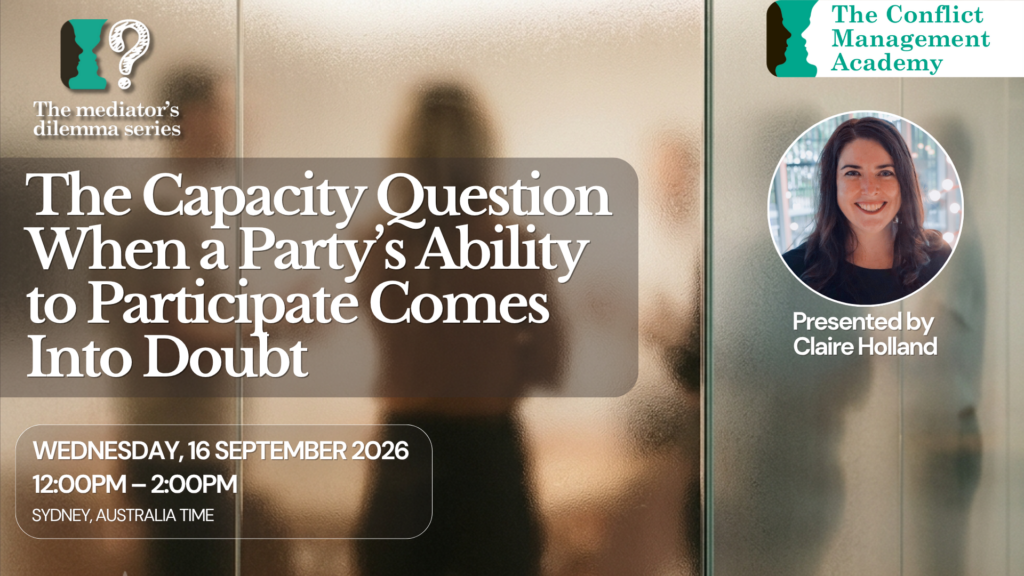
Fit to Proceed? (September 16) Claire Holland
When cognitive decline, mental health, or substance use may be clouding judgment – how does a mediator manage questions about capacity?

Here by Choice? (November 20) Judith Rafferty
They’re in the room, but they don’t want to be. Maybe they were sent by a lawyer, pressured by family, or mandated by an employer. Can meaningful mediation happen when one party is only going through the motions? And when does reluctance cross into something more concerning?
 

Access recordings of past sessions:

by Dr Judith Rafferty

You are mediating what starts out to appear as a typical workplace conflict. But as the mediation progresses, you are increasingly concerned by the behaviour of one of the parties. Things get worse as the mediation continues. The mediation ends, but you can’t sleep that night. What if the worst case scenario happens? Are lives in danger? Is confidentiality more important than your concerns? Should you raise your concerns with the Manager who referred the case? Should you raise your concerns directly with the employer?

In this session you will explore the principle of confidentiality and debate under which circumstances confidentiality may be breached. You will also discuss the concept of “Perceived threat to human life or safety” and how you would determine whether your concerns are justified or not. You will be presented with a few twists in the story to demonstrated how the context may impact your decision.

In a remote mediation office, you’re the sole practitioner navigating a property dispute that seems, at first glance, relatively straightforward. Emily and Michael are back for round two—after a failed attempt at mediation last year, they’re now focused on dividing their assets. With financial disclosures exchanged and a session booked, the process appears smooth—until an unexpected phone call changes everything. It’s a small town. Everyone knows (almost) everything about everyone else. Suddenly you are finding out all sorts of things that seem to change the way this mediation should play out.

In this session you will explore the tension between good faith, fairness and justice, impartiality and confidentiality. What happens when the mediator knows information that one of the parties does not?

by Dr Samantha Hardy

Emma and David, co-founders of a high-profile sustainability startup, enter mediation to resolve their deepening dispute. A confidentiality agreement is in place—but things quickly spiral out of control. From secret investor offers and accusations of mediator breaches, to covert recordings, LinkedIn subtext, and workplace gossip, this case throws up real-world dilemmas every mediator could face.

Should the mediator have disclosed more—or less? Is confidentiality a shield, a sword, or something in between? What happens when parties weaponize confidentiality—or claim breaches without evidence?

by Dr Judith Rafferty

What happens when the real conflict isn’t just between the parties — but between the mediators themselves? 

How do you manage different mediator styles? 

What happens when your co-mediator breaches confidentiality? 

When should you overtly disagree with your co-mediator for the sake of the parties? 

How do you provide constructive feedback for a mediator who doesn’t seem to realise the impact of their approach?

Not every mediation is a good fit—and sometimes the hardest decision is whether to say yes in the first place.

In this next instalment of The Mediator’s Dilemma, we’ll explore real-world scenarios where mediators face tough calls before the process even begins. What do you do when you know one party socially? When there’s a serious power imbalance? When the dispute raises ethical concerns, or touches on your own values?

Join us for an interactive session where we’ll unpack the grey zones mediators navigate in intake and decision-making. You’ll hear from experienced practitioners, test your instincts against the crowd, and reflect on how you assess suitability, safety, and neutrality.

by Dr Claire Holland

Join us for this challenging Mediator’s Dilemma exploring power imbalances in residential tenancy mediations. Through a realistic bond dispute scenario, you’ll navigate the ethical and practical complexities that arise when an experienced property manager faces off against a distressed, under-resourced tenant. This session examines six critical decision points mediators face, from managing procedural fairness when one party dominates through superior documentation and legal knowledge, to handling situations where you suspect prior knowledge about a party’s credibility, to responding when a party breaks down emotionally after reaching an agreement they consider unfair. Whether you’re new to tenancy mediations or a seasoned practitioner, this recorded session offers rich material for reflection on impartiality, party self-determination, and the mediator’s role when systemic disadvantage plays out in your mediation room.

by Catherine Davidson

What happens when private disclosures in mediation cross the line into intimidation? In this Mediator’s Dilemma, Catherine Davidson presents a gripping scenario: a workplace dispute spirals when an employer attempts to use damaging personal allegations as leverage, and both sides begin raising claims well beyond the original contract breach.

This session will challenge you to consider:

  • How should mediators respond when “confidential” information feels more like coercion than negotiation?
  • Where do we draw the boundary between relevance and weaponisation?
  • When serious allegations emerge, is it still possible to maintain impartiality and keep the process safe?

Join us for an interactive exploration of these questions, and test your own judgment against one of the toughest ethical dilemmas mediators face

by Dr Samantha Hardy

You know the codes. You follow the standards. But what happens when a case presses on something you believe deeply?

This session dives into the quiet, personal side of ethics, when a mediator’s own values become part of the story. From family traditions to corporate controversies, we’ll explore where neutrality meets humanity, and how to stay grounded when your moral compass starts to spin.

by Dr Samantha Hardy

You’re mediating a workplace conflict. Before the session even begins, one party pulls you aside to question the other’s mental capacity. Later, you overhear a phone call you weren’t meant to hear. One party treats you like an ally. The other asks for your advice. And just when you think you’ve reached agreement, an allegation of drug use lands in your lap.

Join us for an interactive session where we’ll work through a realistic workplace mediation scenario that raises hard questions about:

→ Neutrality when one party seeks alignment → Managing private session time imbalances → Capacity concerns raised by an opposing party → Requests to deliver feedback “on behalf of” a party → Reality-testing agreements built on questionable assumptions → Late-breaking allegations that change everything

No easy answers. No right answers. Just the kind of messy, real-world situations that keep mediators awake at night.

Whether you’re a seasoned practitioner or newer to the field, this is a chance to test your instincts, hear how others would handle it, and reflect on your own practice.


What happens when the professional distance you thought you had suddenly disappears?

In this session of The Mediator’s Dilemma, we explore a scenario that begins with a breakthrough and ends with a web of impossible choices. A volunteer mediator working with a young person through a restorative justice program discovers that their professional relationship is far more personal than they ever imagined.

As the connections multiply and the stakes rise, our mediator must navigate questions that have no easy answers:

  • When does a conflict of interest become disqualifying?
  • What do we owe to confidentiality when it conflicts with our own interests?
  • How do our values about rehabilitation and second chances shape our professional judgment?
  • At what point do good intentions stop being enough?

Join Rikki Mawad for an interactive exploration of one of mediation’s most challenging territories: when the boundaries between our professional and personal lives begin to blur.

This session is essential for mediators working in community settings, restorative justice practitioners, and anyone who has ever wondered how they would respond when a case gets too close to home.

Let the discussions begin!

Annual Pass

$299+GST