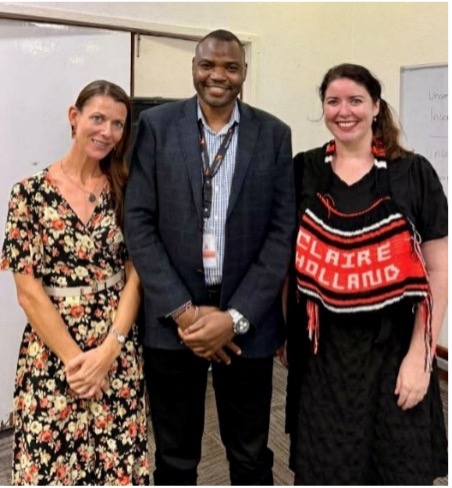
Dr Judith Herrmann-Rafferty, Paul KIGGWE, & Dr Claire Holland
Over the past 14 months, Dr Claire Holland has served as Monitoring, Evaluation, Accountability and Learning (MEAL) Advisor and Mentor with World Vision Papua New Guinea (WVPNG) in Port Moresby, leading a series of multi-day Learning and Reflection workshops to strengthen organisational capability. Under the leadership of the Program Impact and Effectiveness Manager, Paul KIGGWE, and Deputy Manager, Willie Kunsei, the Program Quality Team at WVPNG has focused intentionally on improving data quality and M&E processes. The most recent workshop, held in March 2026, brought together 47 operational and M&E staff from across Papua New Guinea and focused on building stronger evidence systems through data quality and qualitative research skills.*
Dr Holland facilitated the opening two days on data quality, programme accountability and practical systems for ensuring information is accurate, timely, consistent and ethically collected. Participants explored how high-quality data is essential for NGOs to understand community needs, measure outcomes, demonstrate impact to partners and donors, and support sound organisational decision making, including the effective allocation of resources across diverse operating contexts. The sessions also emphasised that quality data is fundamental to capturing community voices accurately and reporting them clearly and ethically. Central to this approach was the principle that communities are the rightful owners of their data and should benefit from how it is used.
For the final three days, Dr Judith Herrmann-Rafferty was invited to deliver an intensive qualitative research training, co-facilitated by Dr Holland. Rather than teaching methods in isolation, the training used an immersive case-study model that followed a single fictional research project from design to dissemination. The scenario, Justice on the Ground: Informal Conflict Resolution in Tarunga, was set in a remote Pacific context and reflected many of the practical and ethical complexities faced in field settings, including parallel justice systems, gender-based violence, sorcery accusations, conflicts of interest, blurred boundaries between civil and criminal matters, and difficult access environments. The scenario was developed by Dr Herrmann-Rafferty and drew directly on her own fieldwork in remote areas of the Central African Republic and Rwanda.
Day Three focused on research design and ethics. Participants developed research questions based on the Tarunga case scenario, identified stakeholder groups, and worked through ethical risk assessment processes. This enabled participants to consider how qualitative research must be adapted to local contexts, such as working with community leaders, women survivors, police, and government officials, while protecting participants and maintaining integrity.
Day Four centred on data collection and analysis. Participants designed interview and focus group guides for different stakeholder groups, observed a live demonstration of a semi-structured interview, and then worked with fictional transcripts, including interviews with a district administrator, a village chief, and a police officer, and focus groups with women, and community leaders, to develop codebooks and identify emerging themes. This practical approach linked data collection directly to the analytical decisions required to generate credible findings.
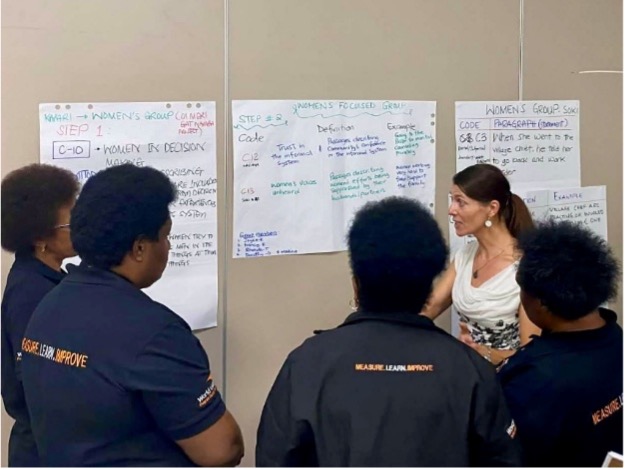
Day Five addressed reporting, utilisation and communication. Participants considered how findings should be tailored for different audiences, from donors and senior management to community members, and drafted concise evidence products based on their analysis. Dr Claire Holland and Dr Judith Herrmann-Rafferty also delivered practical lessons on using data effectively in report writing, drawing on Dr Holland’s earlier training on the distinction between research and reporting. This reinforced the importance of understanding how data will be used, collecting it ethically, and presenting it clearly. Strong links were also made to programme accountability, emphasising the responsibility to share findings and insights back with participating communities. A key takeaway from the training is that data has greatest value when it is translated into accessible, useful information that informs decisions and strengthens accountability.
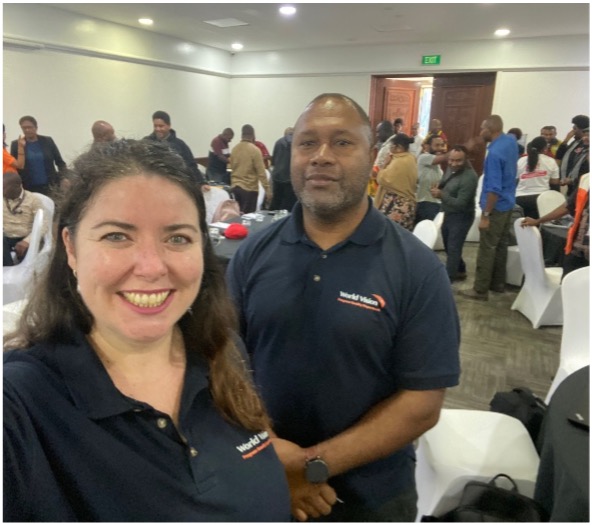
Dr Claire Holland & Willie Kunsei
Participant feedback indicated substantial gains in confidence and strong demand for further training. Before the qualitative data training, the majority of participants rated their knowledge as very limited. Afterwards, no participant rated themselves below a basic competency level, with nearly a third describing themselves as strong and confident. Qualitative feedback gathered pointed to specific moments of genuine insight, including one participant’s reflection that silence in an interview is itself data, and that capturing and interpreting it is the researcher’s responsibility.
The focus of this training was directly informed by the WVPNG 2025–2026 M&E Staff Training Plan, developed through a facilitated group session and individual surveys conducted during the June 2025 L&R Workshop. The plan identified priority areas for professional development, including Writing and Communication, Quantitative and Qualitative Data Analysis, Advanced Excel and Power BI, Theory of Change, KoboToolbox, Writing Impact Stories, Data Visualisation and Infographics, and Logframe and Indicator Development.
The strong demand for topics such as Quantitative and Qualitative Data Analysis, and Writing and Communication, reflects a recognised need among humanitarian and development staff to strengthen core analytical and communication capabilities. In this context, the training delivered represents a timely and practical investment in staff capacity, aligned to expressed learning priorities and organisational needs and highlights how sustained capacity building, combined with applied academic expertise, can support a whole-of-organisation approach to learning, accountability and evidence-informed practice.
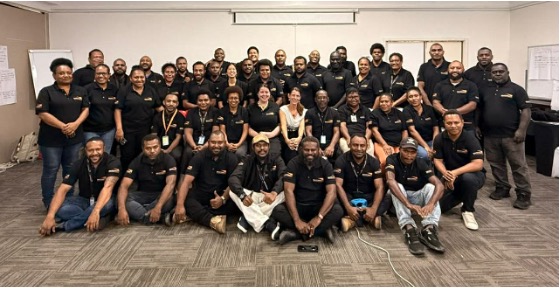
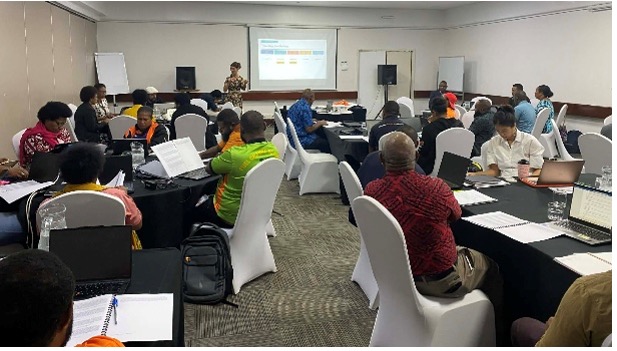
World Vision PNG Learning and Reflection Workshop Participants
*Acknowledgement: Appreciation is extended to Tony, Nancy, Ezra and Dante for training coordination and workshop support; to the Program Quality staff for their contributions to Day One; to the Digital Systems team, including Paul and Willie, for their presentations; and to Acting National Director Godfrey Bongomin, Program Development and Quality Director Christabel Chan, and Program Impact and Effectiveness Manager Paul Kiggwe for their leadership and support throughout the program.