
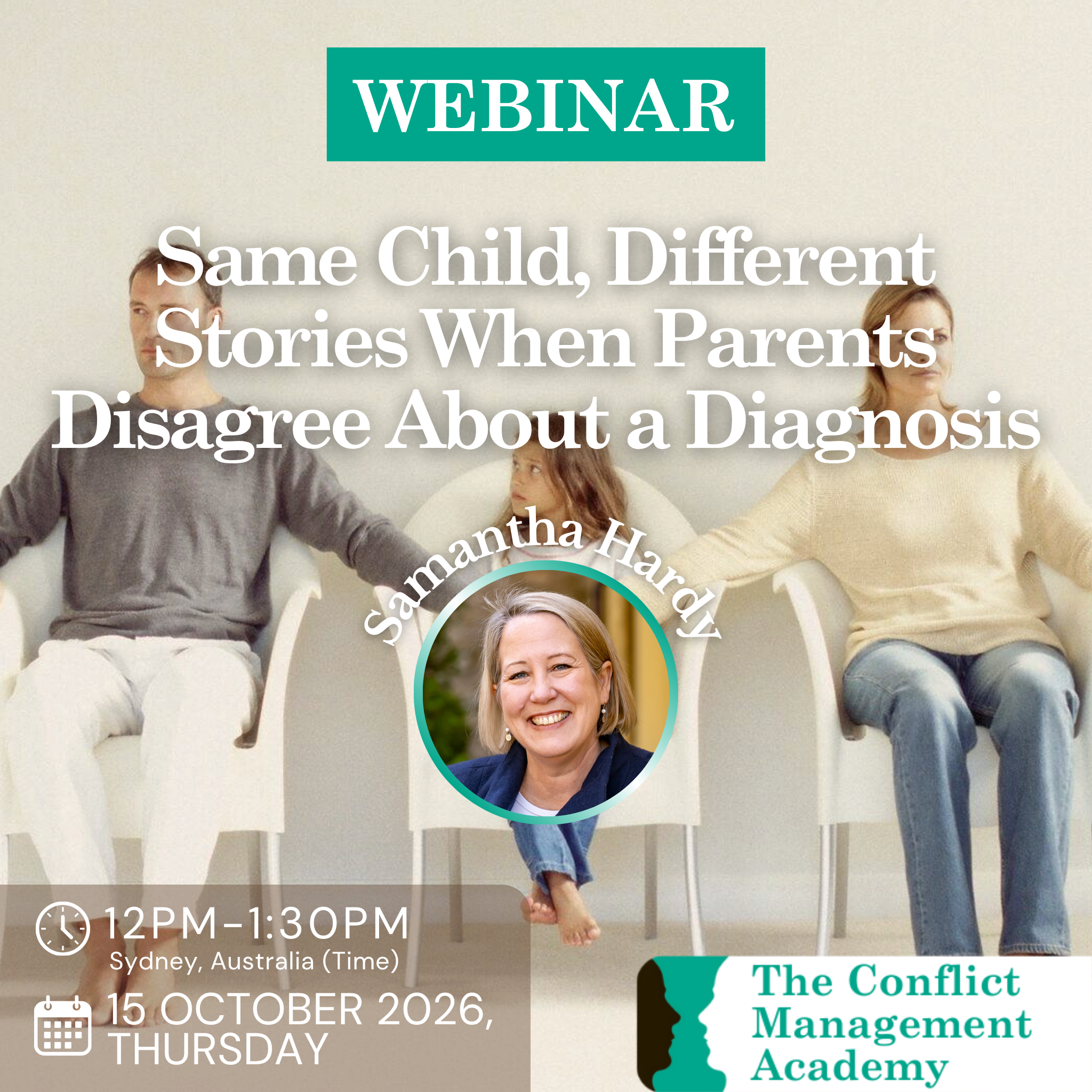
WEBINAR: Same Child, Different Stories When Parents Disagree About a Diagnosis
To receive the zoom link, REGISTER HERE:
https://conflictmanagement.tangiblelaunchpad.com/webinar-same-child-different-stories/
A webinar for FDRPs and others who help parents decide what is best for their child.
One parent wants their child assessed for autism. The other does not see what there is to assess. Each one believes they are protecting the child. Neither can hear the other. And you are the one sitting between them, holding a conversation that the child needs them to finish.
The conversation that goes nowhere
You have probably sat in this room. One parent has read everything and already lined up a referral. The other sees a child who is shy, or strong willed, and no different from how they were at that age, and hears the word autism as a verdict on their parenting. The longer the disagreement runs, the harder each parent digs in. The child waits.
Your job is not to decide whether the child is autistic. You are not there to settle the diagnostic question, or to move one parent across to the other’s view. You are there to help two parents who love the same child have a conversation that has stopped being possible on their own.
This is harder than it looks. The neurotype question is rarely only about neurotype. Underneath it you often find grief, fear of what a label will do to the child, a parent’s own undiagnosed history, and the pull of every other dispute in the separation. Assessment can quietly become the ground on which a different fight is being held.
What you will take away
This webinar gives you a way to hold the conversation that keeps the child at the centre and does not ask you to take a side on the diagnosis. You will leave able to:
- Hold the conversation without taking a position on the diagnosis. Help parents think clearly about assessment without becoming the person who decides whether their child is autistic.
- Separate what each parent observes from what they interpret. Parents in this conflict are usually describing the same child. They part ways at meaning, not at observation. Naming that difference gives them somewhere to stand together.
- Treat one parent’s resistance as information rather than denial. A parent who does not want their child assessed almost always has reasons that matter. Understanding those reasons does more for the child than arguing them away.
- Keep the child in view when the label question grows large. A diagnosis, or its absence, does not tell you what this child needs on a Tuesday morning. The work is about the child, not the word.
- Recognise when the assessment dispute is carrying other conflict. When the real argument is about contact arrangements or who knows the child best, it helps to see that plainly.
- Find language for assessment, support, and uncertainty that parents can actually use with each other.
A different starting point
It is easy to read the resistant parent as the problem to be solved. This webinar starts somewhere else.
Naming a neurotype is the beginning of a question, not the end of one. That holds for the parent pushing for assessment as much as for the parent resisting it. A label settles less than people expect, and its absence settles less than people fear. What the child needs from one day to the next does not wait for the question to be answered, and a good conversation can attend to the child long before anyone agrees on a name.
Who it is for
This webinar is written for the practitioners who end up in the middle of these conversations:
- Family dispute resolution practitioners
- Family report writers and child consultants
- Child contact service staff
- Family lawyers
- Mediators and conflict coaches working with separated parents
You do not need a background in autism or neurodivergence. The focus is on the conflict and the conversation.
About the presenter
Dr Samantha Hardy is the founder of the Conflict Management Academy and the developer of Working with Neurodivergent Clients in Conflict, a professional training program for conflict resolution practitioners. She has worked in the field for more than thirty years as a practitioner, trainer, and researcher, with a background in law and dispute resolution. She received the Resolution Institute Award for Service to Dispute Resolution in 2021 and was named Conflict Coach of the Year in 2022.
Questions you might have
Will this tell me how to recognise autism in a child?
No. This is not assessment training, and your role is not the place for that call. The webinar is about the conversation between the parents, not the diagnosis of the child.
I work with these families but I am not an FDRP. Is it still for me?
Yes. The conversation comes up for lawyers, report writers, contact service staff, and coaches as often as it does for FDRPs. The approach is the same.
What if one parent really is refusing something the child clearly needs?
The webinar deals with this directly. Holding the conversation well and naming a genuine concern for the child are not in tension. You will leave with a way to do both while keeping your impartiality.
-
00
days
-
00
hours
-
00
minutes
-
00
seconds
- Oct 15 2026
- 12:00 pm - 1:30 pm