
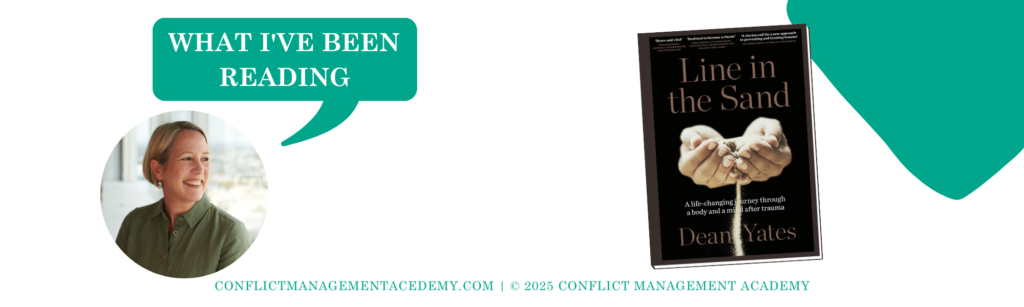
Some books inform you. Others transform you. Dean Yates’s memoir Line in the Sand does both, and it does so with a raw honesty that will leave you profoundly changed.
Yates spent 26 years as a journalist with Reuters, much of that time in some of the world’s most dangerous places. He covered the 2002 Bali bombings. He witnessed the aftermath of the 2004 Boxing Day tsunami in Aceh. He served as bureau chief in Baghdad during one of the most violent periods of the Iraq War. These experiences accumulated in his body and mind like sediment, layer upon layer of trauma.
But it was one event that finally undid him. In July 2007, two of his Iraqi colleagues, photographer Namir Noor-Eldeen and driver Saeed Chmagh, were gunned down by an American Apache helicopter on a Baghdad street. Yates was 20 minutes away in the Reuters office. As their bureau chief, he carried the weight of their deaths. When WikiLeaks later released the helicopter footage as “Collateral Murder,” the world saw what had haunted Yates for years: the casual cruelty, the mistaking of a camera for an RPG, the callous response when children were discovered among the wounded.
What followed was what Yates describes as the unravelling of everything he thought he knew about himself. In 2016, he was diagnosed with post-traumatic stress disorder, a diagnosis that ended his journalism career. Later, he would learn he was also suffering from something called moral injury, a term that may be less familiar but is equally devastating. While PTSD relates to fear and threat, moral injury concerns the shattering of one’s moral framework. It’s what happens when you witness or participate in events that violate your deepest beliefs about right and wrong, about how the world should work, about who you are as a person.
This distinction between PTSD and moral injury is one of the book’s most valuable contributions. Yates doesn’t just tell his story; he takes us through the literature, the research, and the emerging understanding of how trauma operates on multiple levels. He draws on thinkers like Viktor Frankl, researchers like Bessel van der Kolk, and the growing body of work on moral injury to help readers understand what happened to him and what might be happening to others who have witnessed the worst of humanity.
The memoir traces Yates’s journey through multiple admissions to Ward 17, a psychiatric unit in Melbourne that specialises in treating trauma. We learn about the therapeutic approaches that helped him: EMDR, mindfulness meditation, breathing exercises, and crucially, the slow work of examining and processing traumatic memories. He likens the recovery process to a cupboard with linen spilling out, the task isn’t to stuff everything back in and slam the door shut, but to slowly examine each piece, fold it carefully, and place it back in order.
What makes this book particularly powerful is Yates’s unflinching self-examination. He doesn’t cast himself as simply a victim of circumstance. He wrestles with his own choices, his own failings, and the ways trauma rippled outward to affect his wife Mary and their three children. There’s a line that has stayed with me: “Trauma is like a cluster bomb. Everyone around you gets hurt.” This acknowledgment of the collateral damage of his own suffering adds a dimension of accountability that elevates the memoir beyond a simple tale of victimhood and recovery.
There is hope here too. Yates went on to become Reuters’ Head of Mental Health Strategy, channelling his experience into advocacy and support for others in high-stress professions. He has become a fierce champion for workplace mental health, a speaker, and a guide for those walking similar paths. The book itself is an act of generosity, an offering to others who may recognise themselves in these pages and find, perhaps for the first time, a language for what they’re experiencing.
Line in the Sand is not an easy read. There are passages that will make you weep, scenes that will turn your stomach, and moments of darkness so profound you’ll need to put the book down and breathe. But it is a necessary read, for anyone working in high-stress environments, for those supporting people with trauma, for mental health professionals, and frankly, for anyone seeking to understand the full cost of the violence we too often witness from a comfortable distance through our screens.
We were fortunate to have Dean Yates present a webinar on Moral Injury earlier this month, and the recording is now available as a webinar on demand. You can register to view it here:
https://conflictmanagement.tangiblelaunchpad.com/webinar-on-demand-moral-injury/