

I remember a conversation with a mediator who told me, quietly and almost apologetically, that they felt unprepared to manage conversations where racism sat just beneath the surface. They were confident with commercial disputes, workplace clashes, and even heavy family breakdowns. But when an intake form hinted at racial tension, or when a participant made a culturally loaded comment, something shifted.
They found themselves freezing. Second-guessing. Wondering how to remain impartial while also upholding fairness and ensuring safety.
If you recognise that feeling, you are not alone. Many mediators quietly worry about how to handle racism in the room. It is rarely discussed in training, sometimes dismissed as too political, and often misunderstood as something outside the mediator’s remit. Yet racism influences conflict in subtle and significant ways, whether or not it is named openly.
This blog explores what mediators need to hold in mind when issues of race, identity, and racism appear in the background or foreground of a dispute. It steps through the myths, the responsibilities, and the practical realities of doing this work with integrity and courage.

Understanding What We Mean by Racism
To work effectively with racialised conflict, we need a shared vocabulary. Racism is not just about individual attitudes or overt hostility. Scholars like Beverly Daniel Tatum describe racism as a system that produces inequitable outcomes, even when individuals do not intend harm.
Three helpful layers for mediators are:
Individual racism: personal beliefs, stereotypes, or discriminatory behaviour.
Interpersonal racism: racial bias expressed through communication, such as microaggressions or dismissive comments.
Structural racism: the systems, norms, and histories that advantage some groups and disadvantage others.
When participants come to mediation, they bring their entire context with them. The conflict in front of us might involve a workplace performance concern, a neighbourhood dispute, or a community disagreement. But just beneath that storyline are the identity-based experiences that shape how safe each person feels, how they interpret behaviour, and how they make sense of fairness.
If mediators pretend these dynamics do not exist, the process can unintentionally reinforce old hierarchies. If we learn to see them, we gain the ability to design a process that is fairer, safer, and more humane.

Understanding What We Mean by Racism
To work effectively with racialised conflict, we need a shared vocabulary. Racism is not just about individual attitudes or overt hostility. Scholars like Beverly Daniel Tatum describe racism as a system that produces inequitable outcomes, even when individuals do not intend harm.
Three helpful layers for mediators are:
Individual racism: personal beliefs, stereotypes, or discriminatory behaviour.
Interpersonal racism: racial bias expressed through communication, such as microaggressions or dismissive comments.
Structural racism: the systems, norms, and histories that advantage some groups and disadvantage others.
When participants come to mediation, they bring their entire context with them. The conflict in front of us might involve a workplace performance concern, a neighbourhood dispute, or a community disagreement. But just beneath that storyline are the identity-based experiences that shape how safe each person feels, how they interpret behaviour, and how they make sense of fairness.
If mediators pretend these dynamics do not exist, the process can unintentionally reinforce old hierarchies. If we learn to see them, we gain the ability to design a process that is fairer, safer, and more humane.

Understanding What We Mean by Racism
To work effectively with racialised conflict, we need a shared vocabulary. Racism is not just about individual attitudes or overt hostility. Scholars like Beverly Daniel Tatum describe racism as a system that produces inequitable outcomes, even when individuals do not intend harm.
Three helpful layers for mediators are:
Individual racism: personal beliefs, stereotypes, or discriminatory behaviour.
Interpersonal racism: racial bias expressed through communication, such as microaggressions or dismissive comments.
Structural racism: the systems, norms, and histories that advantage some groups and disadvantage others.
When participants come to mediation, they bring their entire context with them. The conflict in front of us might involve a workplace performance concern, a neighbourhood dispute, or a community disagreement. But just beneath that storyline are the identity-based experiences that shape how safe each person feels, how they interpret behaviour, and how they make sense of fairness.
If mediators pretend these dynamics do not exist, the process can unintentionally reinforce old hierarchies. If we learn to see them, we gain the ability to design a process that is fairer, safer, and more humane.

Understanding What We Mean by Racism
To work effectively with racialised conflict, we need a shared vocabulary. Racism is not just about individual attitudes or overt hostility. Scholars like Beverly Daniel Tatum describe racism as a system that produces inequitable outcomes, even when individuals do not intend harm.
Three helpful layers for mediators are:
Individual racism: personal beliefs, stereotypes, or discriminatory behaviour.
Interpersonal racism: racial bias expressed through communication, such as microaggressions or dismissive comments.
Structural racism: the systems, norms, and histories that advantage some groups and disadvantage others.
When participants come to mediation, they bring their entire context with them. The conflict in front of us might involve a workplace performance concern, a neighbourhood dispute, or a community disagreement. But just beneath that storyline are the identity-based experiences that shape how safe each person feels, how they interpret behaviour, and how they make sense of fairness.
If mediators pretend these dynamics do not exist, the process can unintentionally reinforce old hierarchies. If we learn to see them, we gain the ability to design a process that is fairer, safer, and more humane.

What Racism Looks Like in Mediation Rooms
Not all racial dynamics appear as overt statements. Many show up quietly. Some examples mediators often encounter include:
A participant expressing surprise at another person’s English fluency.
A colleague dismissing concerns as oversensitivity.
A participant insisting that cultural practices are illegitimate or inconvenient.
Body language such as eye rolling, sighing, or speaking over a person of colour.
A party weaponising cultural stereotypes to discredit the other.
Expectations that a culturally marginalised person will be the one to compromise.
No single behaviour tells the whole story, but together these patterns shape who feels safe and who feels exposed.

Designing a Fair Process When Racism Is Part of the Story
Mediators can take practical steps at each stage of the process.
1. Intake and Preparation
This is the moment where most of the real work occurs. You can explore:
What are the participant’s goals and fears?
What has been their past experience of conflict in racialised contexts?
What would help them feel heard or safe?
Are there cultural norms or expectations the mediator should understand?
Does the participant want a support person present?
This also gives the mediator time to reflect on their own reactions or assumptions.
2. Process Design
Consider ways to adapt the process without losing impartiality:
Allowing more time for storytelling rather than pushing for fast problem solving.
Checking explicitly for understanding and meaning.
Avoiding jargon that may feel exclusionary.
Paying close attention to asymmetries in turn taking, seating, and pacing.
Offering breaks to restore emotional safety.
These are not special favours. They are part of crafting a process where both parties can participate meaningfully.
3. Facilitation
During the session, practice:
Naming behaviour that undermines dignity or voice.
Slowing the pace when bias emerges, rather than rushing past it.
Using clarifying questions to explore assumptions safely.
Encouraging parties to speak from their own experience rather than generalised claims about groups.
Reflective statements like “I wonder if there is something about identity or background influencing how this is feeling for each of you” can open space without placing blame.
4. Closing and Follow Up
For some parties, the experience of naming racism and being heard is more significant than the outcome. Success can look like:
increased clarity
restored dignity
a sense of procedural fairness
new understanding of each other’s cultural worlds
agreement about next steps
or even a decision that mediation is not the right process
The mediator’s role is to support a process that honours self determination, rather than to pressure a resolution.

The Mediator’s Inner Work: Bias, Discomfort and Courage
This is often the most challenging part. Mediators need to sit with their own reactions. For example:
Do I feel uncomfortable when race is mentioned?
Do I instinctively rush to smooth things over?
Do I avoid naming racism for fear of being seen as taking sides?
Do I downplay racialised harm because I assume the participant is exaggerating?
Do I assume shared norms that may not be shared?
We can only create space for difficult conversations when we learn to tolerate our own discomfort. Brené Brown talks about “the vulnerability of showing up.” In mediation, this includes showing up to our own blind spots.
A reflective practice routine is essential. That might include supervision, journalling, debriefing with trusted colleagues, or attending training focused specifically on race and identity.
Moving Forward As a Profession
Mediators often pride themselves on their capacity for empathy, insight, and calm presence. But racism challenges us to move beyond comfort. It asks us to work with identity honestly, acknowledge power imbalances openly, and design processes that support genuine self determination.
The future of mediation will require greater attention to race, culture, and structural inequality. This is especially important in Australia, where First Nations justice, multicultural identity, and racialised power dynamics shape many of the conflicts we are asked to manage.
We cannot dismantle these structures on our own, but we can ensure our processes do not reinforce them.

Questions to Take With You
Before leaving a mediation involving race or cultural identity, ask yourself:
What did I notice about power, voice, and identity?
What assumptions of mine were activated?
What did fairness look like in practice?
What might I do differently next time?
How well did I honour each person’s dignity?
These questions help build the reflective muscles that AMDRAS and the broader field expect from contemporary practitioners.

Questions to Take With You
Before leaving a mediation involving race or cultural identity, ask yourself:
What did I notice about power, voice, and identity?
What assumptions of mine were activated?
What did fairness look like in practice?
What might I do differently next time?
How well did I honour each person’s dignity?
These questions help build the reflective muscles that AMDRAS and the broader field expect from contemporary practitioners.

A Final Thought
Racism will continue to surface in mediation rooms, sometimes loudly and sometimes quietly. Our job is not to solve racism. Our job is to create a space where people can speak honestly, be heard safely, and make decisions that align with their values and needs.
That work requires skill, humility, preparation, and a willingness to keep learning. If we can do that, we help build a field that is not just procedurally fair, but genuinely responsive to the lived realities of the people we serve.
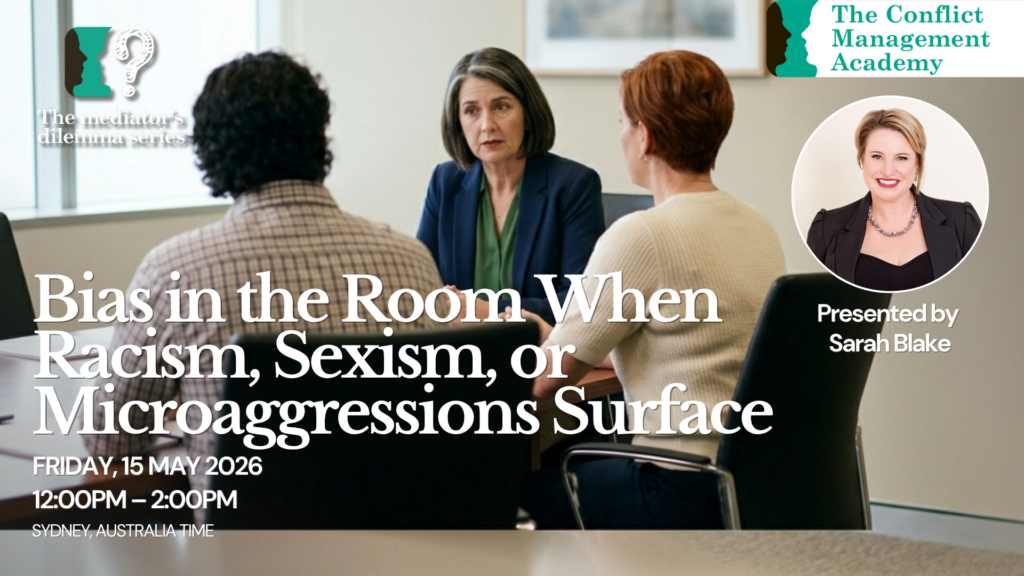
Want to talk about this further?
Join us for our Mediator’s Dilemma session on 15 May when Sarah Blake shares scenarios involving situations when bias enters the room.
https://conflictmanagement.tangiblelaunchpad.com/mediators-dilemma-series
Additional reading:
Parker-Shandal, A. (2025). Anti-Racism in Mediation: Recognizing and Honoring Identity. ABA Dispute Resolution Magazine. https://www.americanbar.org/groups/dispute_resolution/resources/magazine/2025-january/anti-racism-in-mediation/
International Center for Ethno-Religious Mediation. Racially Motivated Conflict Mediation Guide. https://icermediation.org/racially-motivated-conflict-mediation/
Mediators Beyond Borders Anti-racism resources. https://mediatorsbeyondborders.org/anti-racism-resources/
HUE, Colour the Conversation Inclusive Workplace Toolkit. https://huecolourtheconversation.com/shop/p/inclusive-workplace-tookit
Australian Human Rights Commission, Responding to Racism resources. https://humanrights.gov.au/know-your-rights/rights-of-individuals/race-discrimination/guides,-tools-and-resources/responding-to-racism
Sue, D. W. (2010). Microaggressions in Everyday Life. https://www.amazon.com.au/Microaggressions-Everyday-Life-Gender-Orientation/dp/047049140X
Alan E. Gross (2016) Raising awareness of potential biases and microaggressions: Applications to mediation. Journal of Mediation and Applied Conflict Analysis 3(1).