
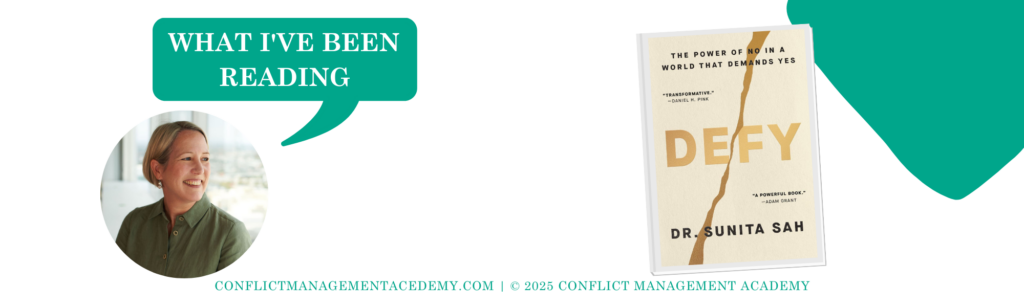
I’ve just finished Defy by Dr Sunita Sah, and it’s one of those books that quietly rearranges how you see everyday interactions.
This isn’t a book about being loud, rebellious, or dramatic. It’s about something far more familiar and far more uncomfortable: how easily we slide into compliance, even when it cuts across our values.
As someone who works with conflict every day, I found myself nodding along more often than I expected.
Although it’s not written specifically for conflict practitioners, Defy speaks directly to the heart of our work: consent, power, pressure, values, and choice.
What really stayed with me
One of Sah’s central ideas is that we are wired for compliance. Obedience is rewarded early, often, and consistently. Over time, our brains learn that “going along” feels safer, easier, and more socially acceptable than resisting. Defiance, by contrast, is framed as risky, rude, or selfish.
What I appreciated most was her reframing of defiance. She defines it simply as:
Acting in accordance with your true values when there is pressure to do otherwise.
That definition alone feels highly relevant for anyone working in ethically complex environments.
Sah also draws a sharp and important distinction between consent and compliance. Compliance is what happens when we go along without real deliberation. Consent, by contrast, is a considered, values-based choice. In conflict contexts, we often treat the two as interchangeable, and that has consequences.
Tension as information, not a flaw
One of the most practically useful ideas in the book is Sah’s treatment of tension. That knot in your stomach. The hesitation you can’t quite explain. The moment you think, “Something about this doesn’t sit right.”
Rather than dismissing tension as anxiety or weakness, Sah reframes it as information. It’s the nervous system flagging a values conflict before the conscious mind has caught up. In other words, tension is evidence of agency.
In conflict practice, we see this constantly. Clients who say “yes” while their body language says otherwise. Agreements that look neat on paper but unravel later. Practitioners who sense something is off but struggle to articulate why.
Sah’s work invites us to take tension seriously. Not as something to smooth over quickly, but as something worth listening to.
Why this matters for conflict practice
Reading this book through a conflict lens, several applications stand out:
- Clients often comply rather than consent, agreeing to outcomes they don’t truly accept, which later re-emerges as resentment, withdrawal, or escalation.
- Power dynamics make defiance riskier for some than for others. Who gets to say “no” safely is not evenly distributed.
- Silence is often misread as agreement, with significant implications for mediation, workplace processes, and so-called voluntary dispute resolution systems.
- Many ethical dilemmas are, at their core, defiance dilemmas. People sense that something is wrong but don’t know how to act on it safely or skillfully.
I was also struck by Sah’s concept of conscious compliance. Sometimes not defying is a strategic, protective choice. That’s not failure. It’s context-aware decision-making. For practitioners, this nuance matters. Not every yes is consent. Not every no is possible.
Small defiance, practiced often
This isn’t a book about waiting for a single heroic moment. It’s about practicing small, everyday acts of alignment: pausing before agreeing, asking a clarifying question, naming discomfort gently, creating distance before deciding.
Sah describes defiance as a muscle. The more we practise it in low-stakes moments, the more capacity we have when the stakes are higher.
For those of us who support people in conflict, this feels like an invitation. How do our processes make room for pause? For uncertainty? For a true yes or a true no?
Reflective prompts for practitioners
- Where do I see compliance mistaken for consent in my work?
- How do I respond when I notice tension, in myself or in others?
- What pressures to “go along” exist in my professional role or organisational context?
- How do my processes support, or undermine, a person’s capacity to give a true yes or a true no?
- When might conscious compliance be an ethical choice rather than a problematic one?
I’d recommend Defy to mediators, conflict coaches, facilitators, managers, and anyone who has ever said yes while quietly thinking no.
It’s thoughtful, research-informed, and deeply humane. And it pairs beautifully with conflict work because, at its heart, this book is about autonomy, values, and choice under pressure.
As Sah puts it, defiance isn’t just about saying no. It’s about saying yes to the person you’re trying to be.