

It’s a deceptively simple question. After all, mediation is voluntary. If one person says no, that should be the end of it. Yet, in practice, mediators are regularly drawn into the space between willingness and refusal. How far should they go in encouraging participation? When does providing information turn into persuasion?
This blog post unpacks the practical and ethical issues that arise when only one party wants to mediate, and explores different ways a mediator might help, or not help, to bring the other party to the table.
The voluntary nature of mediation
Most mediators would likely agree that mediation should be voluntary. In theory, voluntariness protects self-determination: parties choose to participate, shape the agenda, and decide whether to reach agreement. In practice, however, many mediations occur under varying degrees of pressure—social, institutional, financial, or legal. An employee “invited” to a mediation after a grievance, or parents referred by a court, may technically consent while feeling they have little real choice. This exposes a tension between the rhetoric of voluntariness and the realities of power and obligation that shape entry into mediation.
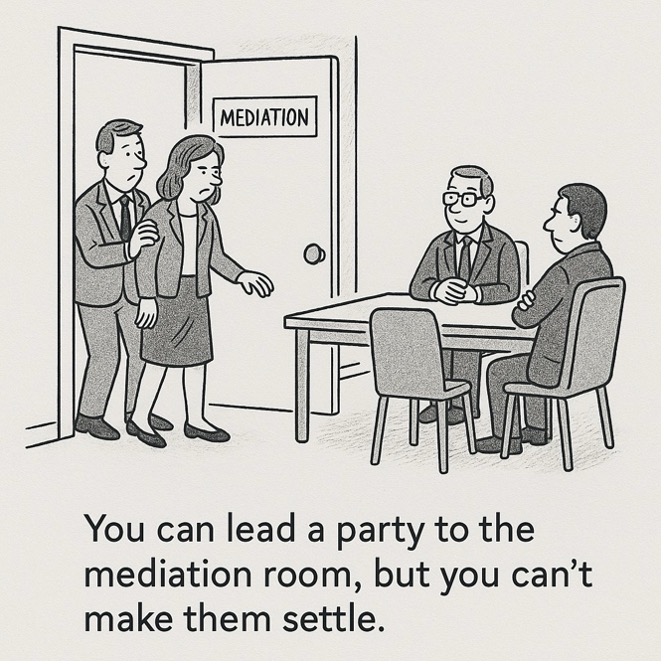
Voluntariness doesn’t mean the decision happens in a vacuum. Parties are always influenced by information, advice, and circumstance. The challenge for mediators is to ensure that influence remains transparent and proportionate, not manipulative.
So the core question becomes: how can a mediator provide enough information to enable an informed choice without steering the choice itself?

Four common approaches to the problem
There are several ways a mediator might become involved when only one party has expressed interest. Each carries different practical and ethical implications.
1. Providing information to Party A only
This is the most conservative and, often, the safest path. The mediator restricts their role to helping Party A understand what mediation is and how to invite Party B appropriately.
Party A can then approach Party B directly, through conversation, letter, or lawyer, using accurate information and clear language. The mediator might provide a neutral “about mediation” fact sheet or a short statement that Party A can share verbatim.
Pros:
The mediator stays comfortably within their neutral role.
Party A is empowered and informed.
There’s no risk of the mediator being perceived as siding with one party.
Cons:
Information may be filtered or misrepresented by Party A, intentionally or not.
Party B might dismiss the invitation as self-serving or manipulative.
The mediator has little control over how their process is portrayed.
Ethically, this approach is low-risk. The mediator’s only duty is to ensure Party A receives accurate, balanced information. The key is clarity: Party A must understand that the mediator is not yet retained by anyone, and that any outreach to Party B must respect the voluntary nature of participation.
2. Mediator contacts Party B to provide neutral information
Here the mediator, with Party A’s consent, contacts Party B directly. The conversation is strictly informational: who the mediator is, what mediation involves, and how it differs from other processes.
Pros:
Party B hears about mediation from a neutral third party rather than through Party A’s lens.
It can build confidence and dispel misconceptions early.
The mediator can model impartiality from the start.
Cons:
If not handled delicately, Party B may feel ambushed or pressured.
The mediator could appear aligned with Party A (especially if Party A initiated the contact).
Confidentiality and privacy issues may arise if the mediator discloses too much about the dispute.
In practice, this approach works best when the mediator keeps the initial message short, transparent, and non-persuasive. For example:
“I understand you’ve been invited to consider mediation. My role is to act as an impartial facilitator if both parties wish to proceed. I’m happy to answer questions about the process so you can decide whether it’s suitable. There’s absolutely no obligation to continue.”
The goal is informed consent, not persuasion. Documenting this communication, even briefly, helps protect both mediator and parties later.
3. Invitation to Party B to meet with the mediator
In some cases, the mediator might meet with Party B privately to discuss the process in more depth. This could involve explaining how mediation might look in this dispute, what the stages are, and addressing specific fears.
Pros:
Can reduce anxiety and level the playing field, particularly when Party B has less experience or power.
Allows the mediator to gauge suitability and potential risks before formal engagement.
May increase the likelihood of voluntary, informed participation.
Cons:
Fine ethical line: detailed conversation can easily slip into advocacy for the process.
If the mediator seems to have a view on what Party B should do, impartiality is compromised.
The ethical test is simple: is the mediator helping Party B decide or is the mediator trying to convince them to engage in mediation? The former is permissible; the latter is not.
Self-determination is the “cornerstone of mediation ethics.” Assisting a party to make an informed decision supports that principle. Pressuring them toward a particular choice undermines it.
4. Actively persuading Party B
The temptation to persuade can be strong. Mediators believe in mediation. We’ve seen it work, and it can be frustrating to watch people choose adversarial paths instead.
Yet active persuasion, using arguments about cost savings, court backlogs, or moral duty, sits uneasily with ethical standards.
Pros:
It sometimes works. People who are sceptical may be convinced by pragmatic reasoning.
In systems where mediation is publicly funded or court-connected, persuasion may be institutionalised.
Cons:
Undermines voluntariness and self-determination.
Risks later claims of bias or coercion.
Can create defensive resistance rather than genuine willingness.
Stark and Frenkel’s empirical work on mediator persuasion shows that subtle persuasive tactics are common but rarely acknowledged. They warn that even well-intentioned persuasion can shift the mediator’s role from facilitator to advocate.
The most ethical posture is transparency: if persuasion is attempted, it should be mild, explicit, and immediately balanced with an affirmation of choice, e.g., “It’s entirely your decision whether to participate; my role is only to make sure you understand the option.”
Other considerations
Timing
Early outreach, when emotions are still raw, can backfire. Sometimes Party B needs time to cool down or gather advice. A gentle, delayed invitation may be more effective.
Power imbalances
If Party A holds more information, money, or institutional power, Party B’s reluctance may stem from self-protection. In such cases, the mediator’s involvement in clarifying process and safeguards can actually enhance fairness.
Cultural and relational context
In collectivist or high-context cultures, relationship and trust precede process choice. A mediator’s respectful, personal outreach may be essential to legitimacy. In legalistic cultures, neutrality requires distance. Context matters.
Confidentiality and data protection
If the mediator contacts Party B directly, they must avoid revealing anything about Party A’s position or motives. Even the fact that Party A “wants resolution” can be sensitive in commercial or workplace disputes.
Institutional frameworks
Court-connected mediations blur voluntariness because participation is often mandated. Here, the mediator’s role in persuasion is less ethically charged but still requires care: even if attendance is mandatory, engagement is not.
Practical guidance for mediators
1.Clarify who your client is and isn’t.
Until both parties agree to mediate, you’re not acting for anyone. Treat each as a potential participant, not a client.
2. Be transparent about your role.
When speaking with either party, explicitly state that your role is impartial and contingent on both agreeing.
3. Separate information from persuasion.
Use process descriptions, not promises of outcome. “Mediation gives you a space to explore options” is information; “Mediation will save you money” is persuasion.
4. Script the initial contact.
A short, respectful invitation protects against misunderstanding:
“I’ve been asked to contact you to see if you’re open to mediation. My role is impartial, I don’t represent either party. I can explain how the process works so you can decide if you’d like to participate.”
5. Provide written materials.
A one-page overview helps ensure consistency and transparency.
6. Keep records of communications.
Document who contacted whom, when, and what was said. This protects against future allegations of bias.
7. Reflect on motive.
Ask yourself: am I helping Party B make an informed choice, or am I trying to secure a case? The answer should determine whether you proceed.
8. De-brief with a colleague or supervisor.
Ethical tensions are easier to see from outside. Reflective practice groups, like the Conflict Management Academy’s Mediator’s Dilemma series, can be a valuable forum for discussing these grey zones.

Bringing it together
So, how should a mediator act when Party A wants mediation but Party B hasn’t agreed?
First, recognise that hesitation is normal. People protect themselves before they open up.
Second, focus on information, not persuasion.
Third, if direct contact with Party B is necessary, keep it neutral, brief, and transparent.
Fourth, reflect on how each action affects both perception and reality of impartiality.
Finally, remember that mediation begins before the session starts, every interaction sets the tone for trust.
Encouraging participation is part of the mediator’s service to the public, but it must be done with a light hand. When Party B says yes because they understand and trust the process, not because they were convinced, that “yes” has integrity. And integrity is the foundation on which all meaningful mediation rests.