WEBINAR STARTS IN:
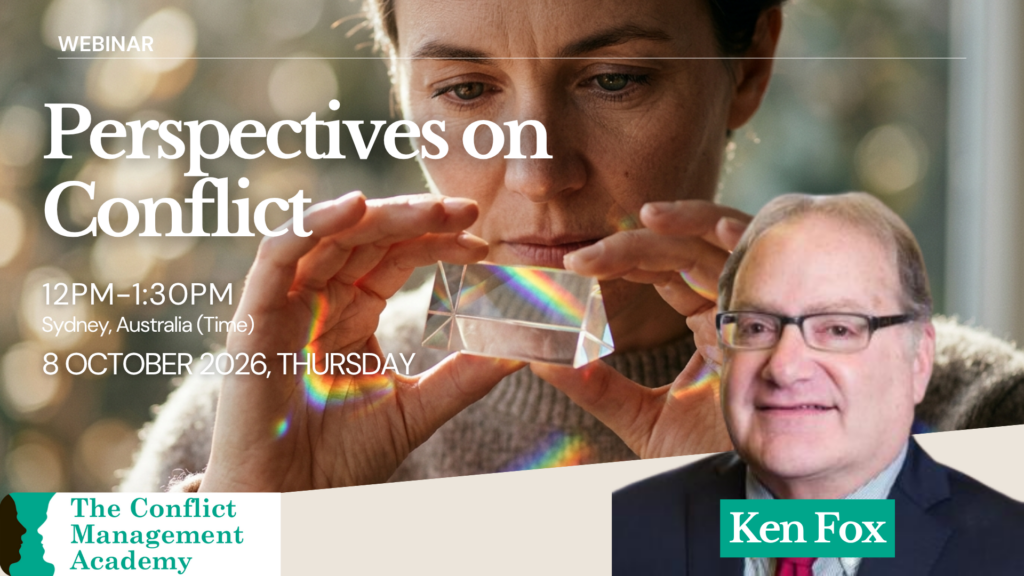
8 OCTOBER 2026, THURSDAY | 12PM-1:30PM SYDNEY AUSTRALIA (TIME)
About the webinar
Most conflict practitioners are well-versed in process and technique. But how often do we stop to examine the assumptions we bring to the room? In this webinar, Professor Kenneth (Ken) Fox draws on his new book Perspectives on Conflict: Insights for Professional and Personal Practice to explore something that is harder to find than another toolkit: a coherent, practitioner-friendly examination of the nature of conflict itself.
Drawing on six broad perspectives — the body, the non-conscious mind, the strategic mind, language and symbols, the co-creation of meaning, and the wider conflict ecosystem – Ken offers a framework for seeing conflict in its full complexity. Conflict, he argues, is never just cognitive, never just emotional, and never just interpersonal. It is embodied, relational, symbolic, and embedded in systems. When practitioners learn to move fluidly between these perspectives, they expand what becomes possible in their work. This webinar also takes seriously the role of reflective and reflexive practice — not just asking “what did I do?” but “how am I making sense of what I am seeing, and why?” For professionals who want language to describe what they intuitively sense but struggle to articulate, this is a session worth showing up for.
Learning Outcomes
By the end of this webinar, participants will be able to:
Describe the six perspectives on conflict framework and explain how each shapes practitioner interpretation and intervention
Identify which perspectives they currently default to in their own practice and which they tend to underuse
Apply a more reflective and reflexive lens to their work, moving beyond outcome-focused evaluation toward deeper examination of how they make sense of conflict situations
Articulate why adopting multiple perspectives matters, particularly when working across mediation, coaching, facilitation, or systems roles
Recognise conflict as simultaneously embodied, relational, symbolic, and systemic -- and begin to account for that complexity in their practice
Engage more thoughtfully with contested concepts such as impartiality and emotional intelligence as ongoing professional tensions rather than fixed competencies
About your trainer:
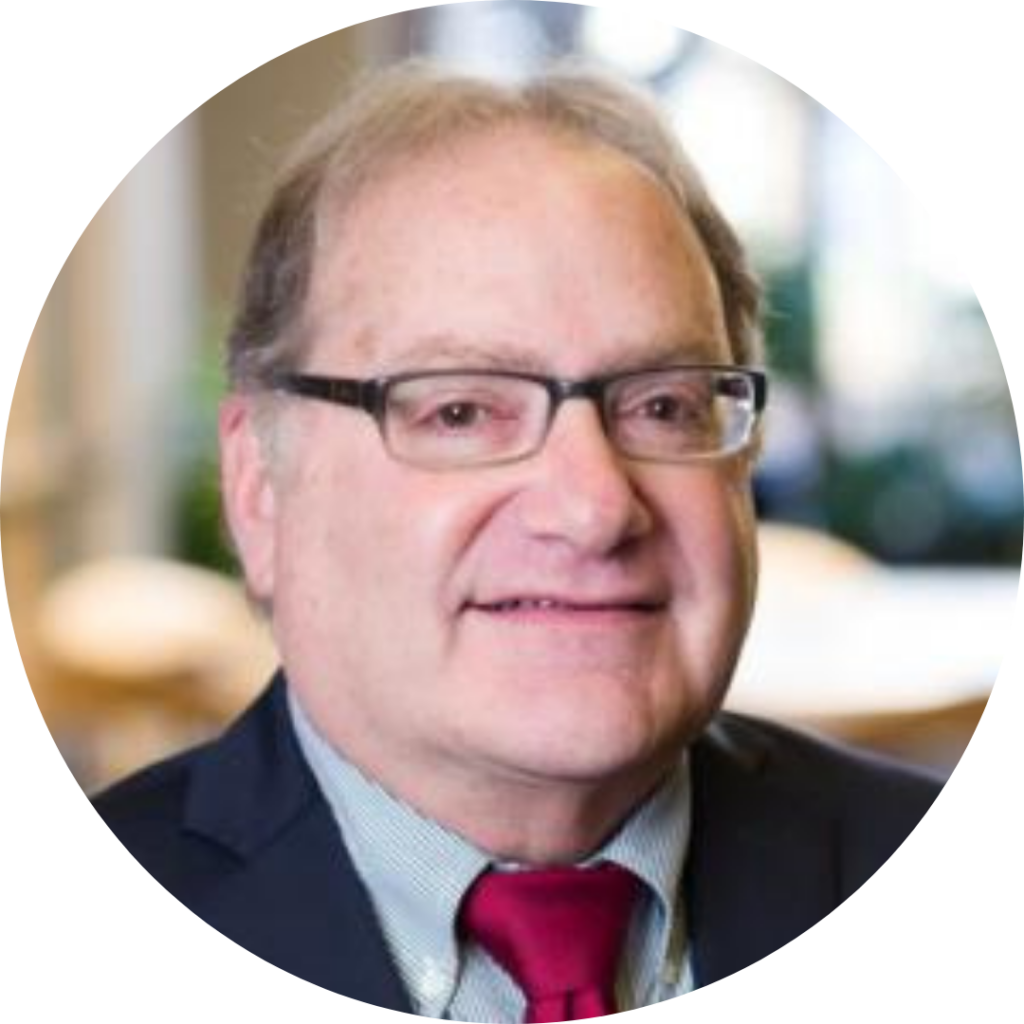
Ken Fox
Professor Fox’s academic interests relate to the many different ways that individuals, groups and societies experience, seek to understand, and work constructively through conflict. His writings focus primarily on mediation, negotiation and conflict theory. He has taught, trained, and/or consulted throughout the United States and in nineteen countries on four continents. He is a Fulbright senior specialist grant recipient through which he taught law, peace and conflict resolution studies at the Riga Graduate School of Law in Latvia. Between 2001 and 2015, Professor Fox was also part of a series of multi-year U.S. State Department-funded civic education, civil society, and conflict transformation (peacebuilding) projects, working in-region and directly with Israeli, Palestinian, Jordanian, and Lebanese educators, business and civic leaders. Since 2006, he has taught annually at the Institute of Training in Mediation and Negotiation (IFOMENE) at the Catholic University of Paris, France and has also taught on multiple occasions at Deusto University in Bilbao, Spain and at Hong Kong Shue Yan University.
Professor Fox received his BA in Rhetoric from the University of California and his JD (Cornelius Honor Society) from Northwestern School of Law at Lewis and Clark College. He also studied philosophy at the University of Liege, Belgium, as a Rotary undergraduate scholar. Professor Fox formerly practiced business and government law and also has a background in adult and experiential education.
Professor Fox takes a conversational approach to his teaching and seeks to engage students in ways that build connections between the classroom and students’ own lived experience.
Register for the webinar by clicking the link below. The webinar will be recorded so if you can't attend live, you will be able to watch the recording later.