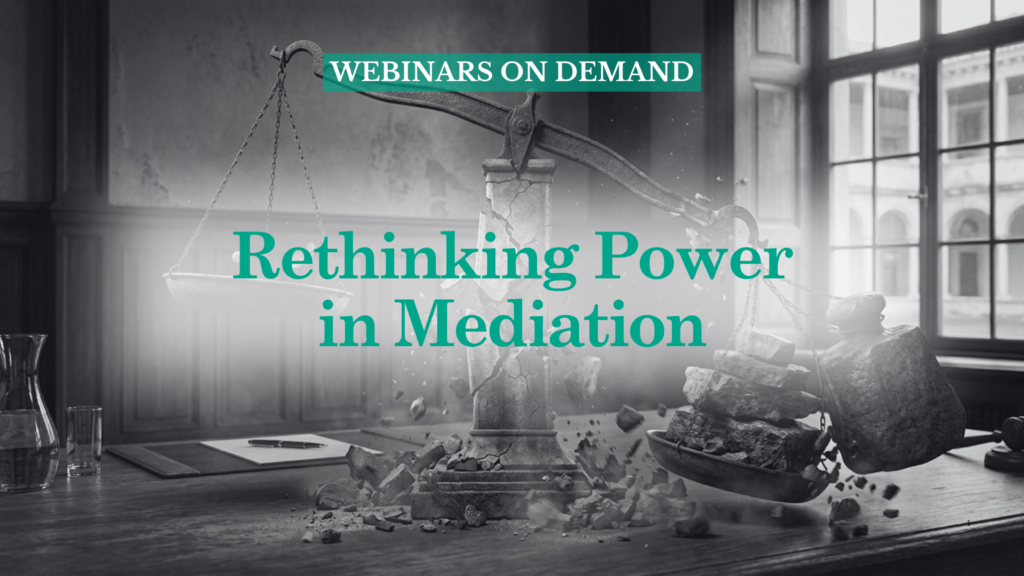
We’re taught to recognise power imbalances and “balance” them. But what if this foundational concept is leading us astray? In this 75-minute webinar, we move beyond surface-level approaches to power and explore why conventional power-balancing techniques may address visible dynamics while leaving deeper structural and psychological dimensions untouched. Drawing on Steven Lukes’ three dimensions of power and Bernard Mayer’s critique of power balancing, participants will develop a more sophisticated understanding of how power operates in mediation – and a more honest assessment of what we can and cannot change.
This webinar challenges comfortable assumptions while remaining grounded in practice. Rather than abandoning your existing skills, you’ll gain a framework for understanding their limits and a practical reframe that shifts the question from “How do I balance power?” to “Does each party have an adequate basis to participate meaningfully?” Through case examples, small group discussion, and guided reflection, you’ll leave with concrete questions to apply in your next mediation.
Learning Outcomes
By the end of this webinar, participants will be able to:
Identify visible, hidden, and invisible dimensions of power operating in a mediation context
Critically evaluate the limitations of conventional "power balancing" approaches and the risk of process legitimation
Apply a practical reframe - from "equal power" to "adequate basis for meaningful participation" - when assessing whether and how to proceed with mediation
Articulate key questions to assess power dynamics across all three dimensions in their own practice
About your trainer:
Dr Samantha Hardy is the Director and Lead Trainer for The Conflict Management Academy. She is an experienced mediator and conflict coach and the founder of the REAL Conflict Coaching System™. She provides conflict support to managers and leaders across the world. She also provides professional development training, supervision and mentorship to mediators and coaches who work with clients in conflict.
Sam is accredited under the Australian Mediation and Dispute Resolver Accreditation System and is a Certified Transformative Mediator by the US Institute of Conflict Transformation. She is a Certified Narrative Coach. In 2021 Sam was awarded the Australian Resolution Institute Award for Service to Dispute Resolution for her leadership and innovation in the field. She was also awarded 2022 Conflict Coach of the Year at the Australian Dispute Resolution Awards.